Article Database
New York Daily News
November 17, 1974
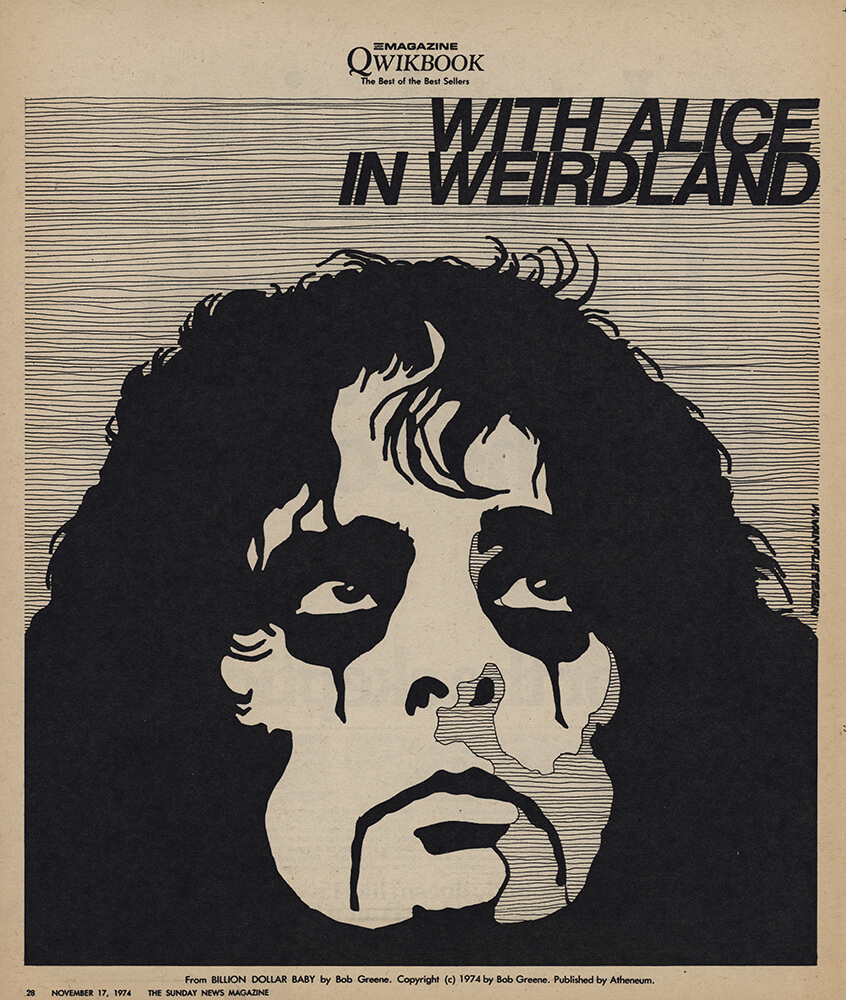
With Alice in Weirdland
What It's Like on Stage And Behind the Scenes With the Alice Cooper Band
Author: By Bob Greene
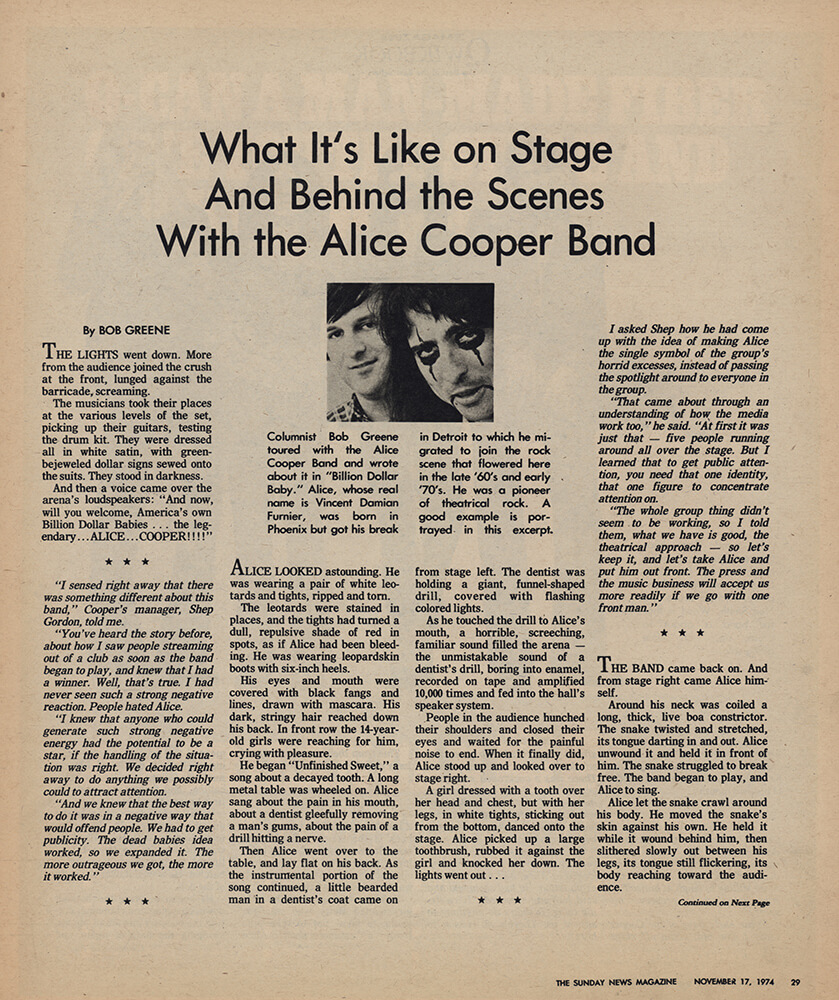
Bob Greene toured with the Alice Cooper Band and wrote about it in "Billion Dollar Baby." Alice, whose real name is Vincent Damon Furnier, was born in Phoenix but got his break in Detroit to which he migrated to join the rock scene that flowered here in the late '60's and early '70's. He was a pioneer of theatrical rock. A good example is portrayed in this excerpt.
THE LIGHTS went down. More from the audience joined the crush at the front, lunged against the barricade, screaming.
The musicians took their places at the various levels of the set, picking up their guitars, testing the drum kit. They were dressed all in white satin, with greenbejeweled dollar signs sewed onto the suits. They stood in darkness. And then a voice came over the arena's loudspeakers: "And now, will you welcome, America's own Billion Dollar Babies... the legendary... ALICE... COOPER!!!!"
● ● ●
"I sensed right away that there was something different about this band," Cooper's manager, Shep Gordon, told me.
"You've heard the story before, about how I saw people streaming out of a club as soon as the band began to play, and knew that I had a winner. Well, that's true. I had never seen such a strong negative reaction. People hated Alice.
"I knew that anyone who could generate such strong negative energy had the potential to be a star, if the handling of the situation was right. We decided right away to do anything we possibly could to attract attention.
"And we knew that the best way to do it was in a negative way that would offend people. We had to get publicity. The dead babies idea worked, so we expanded it. The more outrageous we got, the more it worked."
● ● ●
ALICE LOOKED astounding. He was wearing a pair of white leotards and tights, ripped and torn.
The leotards were stained in places, and the tights had turned a dull, repulsive shade of red in spots, as if Alice had been bleeding. He was wearing leopardskin boots with six-inch heels.
His eyes and mouth were covered with black fangs and lines, drawn with mascara. His dark, stringy hair reached down his back. In the front row the 14-yearold girls were reaching for him, crying with pleasure.
He began "Unfinished Sweet," a song about a decayed tooth. A long metal table was wheeled on. Alice sang about the pain in his mouth, about a dentist gleefully removing a man's gums, about the pain of a drill hitting a nerve.
Then Alice went over to the table, and lay flat on his back. As the instrumental portion of the song continued, a little bearded man in a dentist's coat came on from stage left. The dentist was holding a giant, funnel-shaped drill, covered with flashing colored lights.
As he touched the drill to Alice's mouth, a horrible, screeching, familiar sound filled the arena — the unmistakable sound of a dentist's drill, boring into enamel, recorded on tape and amplified 10,000 times and fed into the ball's speaker system.
People in the audience hunched their shoulders and closed their eyes and waited for the painful noise to end. When it finally did, Alice stood up and looked over to stage right.
A girl dressed with a tooth over her head and chest, but with her legs, in white tights, sticking out from the bottom, danced onto the stage. Alice picked up a large toothbrush, rubbed it against the girl and knocked her down. The lights went out...
● ● ●
I asked Shep how he had come up with the idea of making Alice the single symbol of the group's horrid excesses, instead of passing the spotlight around to everyone in the group.
"That came about through an understanding of how the media work too," he said. "At first it was just that — five people running around all over the stage. But I learned that to get public attention, you need that one identity, that one figure to concentrate attention on.
"The whole group thing didn't seem to be working, so I told them, what we have is good, the theatrical approach — so let's keep it, and let's take Alice and put him out front. The press and the music business will accept us more readily if we go with one front man."
● ● ●
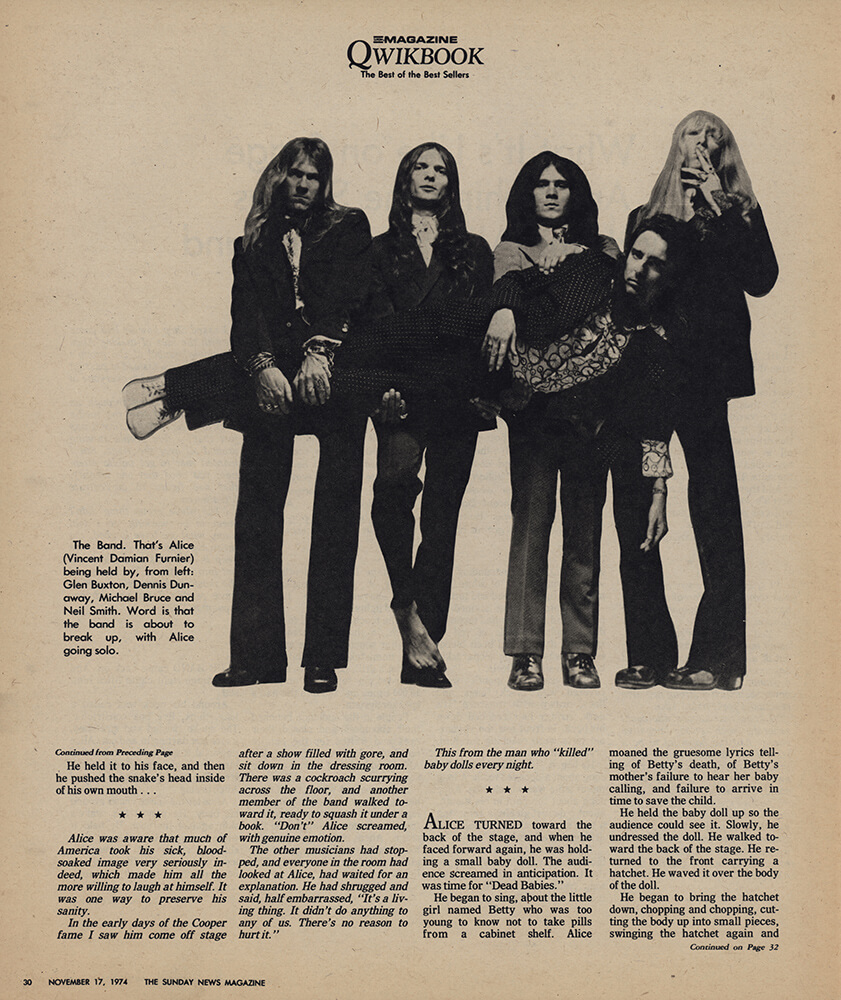
THE BAND came back on. And from stage right came Alice himself.
Around his neck was coiled a long, thick, live boa constrictor. The snake twisted and stretched, its tongue darting in and out. Alice unwound it and held it in front of him. The snake struggled to break free. The band began to play, and Alice to sing.
Alice let the snake crawl around his body. He moved the snake's skin against his own. He held it while it wound behind him, then slithered slowly out between his legs, its tongue still flickering, its body reaching toward the audience.
He held it to his face, and then he pushed the snake's head inside of his own mouth...
● ● ●
Alice was aware that much of America took his sick, bloodsoaked image very seriously indeed, which made him all the more willing to laugh at himself. It was one way to preserve his sanity.
In the early days of the Cooper fame I saw him come off stage after a show filled with gore, and sit down in the dressing room. There was a cockroach scurrying across the floor, and another member of the band walked toward it, ready to squash it under a book. "Don't" Alice screamed, with genuine emotion. The other musicians had stopped, and everyone in the room had looked at Alice, had waited for an explanation. He had shrugged and said, half embarrassed, "It's a living thing. It didn't do anything to any of us. There's no reason to hurt it."
This from the man who "killed" baby dolls every night.
● ● ●
ALICE TURNED toward the back of the stage, and when he faced forward again, he was holding a small baby doll. The audience screamed in anticipation. It was time for "Dead Babies."
He began to sing, about the little girl named Betty who was too young to know not to take pills from a cabinet shelf. Alice moaned the gruesome lyrics telling of Betty's death, of Betty's mother's failure to hear her baby calling, and failure to arrive in time to save the child.
He held the baby doll up so the audience could see it. Slowly, he undressed the doll. He walked toward the back of the stage. He returned to the front carrying a hatchet. He waved it over the body of the doll.
He began to bring the hatchet down, chopping and chopping, cutting the body up into small pieces, swinging the hatchet again and again. A blood-like red liquid poured from the doll's body and spread over the floor of the stage.
All during the performance, Cooper had not allowed a smile to come onto his face, and he was still wearing a grim expression as he chopped...
● ● ●
Shep continued: "I decided that if they were ever going to become a supergroup, then they were going to have to exhibit that star confidence on stage, right from the beginning.
"So I determined as soon as I began to manage them that they would be treated like stars at all times. They would be waited on, catered to, made to feel like they were the most famous performers who ever lived. That way, when anyone from the outside came in contact with our organization, they felt like they were dealing with stars.
"It was the best thing for their careers — I don't think there's any doubt about that. Whether it was the best thing for them as human beings — well, I'm not so sure... I'm afraid that they're all going to find out, in the end, that they've paid a very high price for their success."
● ● ●
"YOU'RE SICK!" Alice screamed into the microphone. "You're all sick! You want to see how sick you are?"
The crowd was shouting and surging toward the stage. The band played on.
"Here!" Alice screamed. He lowered a sword which had been rammed through with a stack of dollar bills within inches of the audience. And the people scrambled and kicked to get to it, to thrust their hands at the blade so that they may come away with a dollar.
Then Alice started to toss posters. They were rolled up into long tubes — pictures of the Alice Cooper band. He kept singing "School's Out," and he teased the crowd with the promise of posters.
When he would notice a particular rough area in the crowd, where people were in danger of toppling over, he would flip a poster into their center, and watch them slug one another and rip their way toward the souvenir.
He began to throw them out faster and faster, and by the end of the song the front of the arena looked like a riot corridor.
I couldn't believe it. I knelt behind the speaker box and watched Alice goad the people on. Ten feet from me, inside the barricades, a plump young usher had noticed that one of the support beams had begun to break. If it went, the barricade would give way and then the thousands of people would fall after it, toward the stage.
The usher tried to shore it up, and a girl in a plain white tee shirt on the other side of the barricade saw what he was doing. She began to try to pull the support beam away, so that the barricade would fall.
She began to reach over and scratch at him, trying to force him to let the barricade drop. The girl lit at him, and finally reached over and took the glasses from his face, and snapped them in two.
I looked up. Shep Gordon was standing beside the spot where I was kneeling. He was laughing: "Ever see anything like it?"
(From the collection of Anders Mossberg. Originally published in The Sunday News Magazine - November 17, 1974)
Images