
Article Database
Jazz & Pop
June 1971
Sweet Perversity
Interview with Alice Cooper
Author: Michelle Hush
It's a strange thing, but one of the most obvious aspects of rock 'n' roll music is the one which is most consistently overlooked: that is, that it is performance, illusion. It is theater. Musicians who wriggle and writhe all over the stage do not continue to do this as they walk down the street. (Usually.) Musicians who smash their guitars and drums do not necessarily go home and smash tables and lamps. And musicians who go on stage and act out neuroses, such as Alice Cooper, are not necessarily raving maniacs.
That Alice Cooper's stage presence is on the bizarre side can not be denied. Nor can one deny that this group carries its eccentricities like a flag. (Long may it wave.) But that is just one part. The outside. Alice Cooper are not escapees from a mental institution, as some would have us believe, nor are they just one of Frank Zappa's little pranks. There is much more than just that.
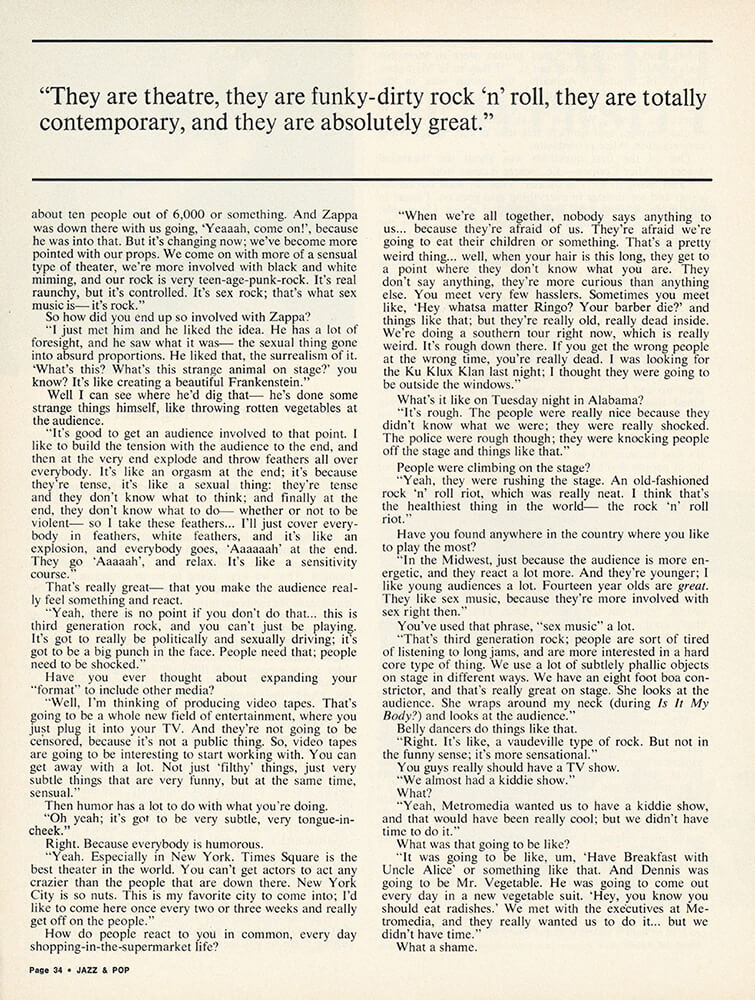
Alice Cooper is a quite extraordinary rock 'n' roll group, and Alice Cooper is also the lead singer of the group by that name. Alice Cooper is a figment of their own imaginations, even a figment of the imagination of the Twentieth Century. They are theater, they are funky-dirty rock 'n' roll, they are totally contemporary, and they are absolutely great.
One might wonder where on earth they came from... and the answer to that is simple: they are a product of this culture and this generation, of newspapers and television, of Elvis Presley and Mick Jagger, of Fred Astaire and Ginger Rodgers, of "Hellzapoppin'" and "Batman." In other words, they're just like the rest of us. Yet they are unique. They have a natural flair for theatrics, which has been cultivated and humored to an amazing extent. They can show us what we, in part, are made of, and they can make us laugh about it. Alice Cooper are therapeutic.
Our own appointment with the world's most unusual shrink came a little while ago, when Alice was in town for one of those "interview days" which plague most musicians. The rest of the band, Neal Smith (percussion), Michael Bruce (guitar, piano, organ), Dennis Dunaway (bass), and Glen Buxton (lead guitar), were in Memphis and, as Alice so succinctly put it, "If they're in Memphis, they're in trouble." Actually, the group was in the midst of a tour of the South, and on their day off, Alice and manager Shep Gordon had flown into New York to "meet the press." We met in an office on the outskirts of the Village, and quickly fell into a very enlightening conversation. Alice is owdasite.
One of the first questions was about the theatrical aspect of Alice Cooper — i.e., where it came from...
"Just living in 1971 is theater. You can walk out on the street and see theater in everything that goes on. I came in this morning in a cab, and I counted about 15 people, business guys, talking to themselves walking down the street. That's pretty crazy... that's pretty theatrical. But then again, maybe it's real. I love watching it.
"We're into that theater because we're projecting what's going on. We're neurotic, that's for sure; you can't live in 1971 and not be neurotic. But see, we have a vehicle to let it out, and that's the main thing. We can be neurotic and at the same time be entertaining, which is the important thing. Very few people have ever done that, have actually been performers by being neurotic.
"I think everybody in the group is just a natural actor, a natural performer. Everybody was in art school together, and everybody was in high school together, and everybody grew up and had their own personality, and we just combined them. It's not like acting, it's a whole different field... I don't even know how to term it. If this was on Broadway it would be a Broadway thing. It's not because we're using a lot of props and a lot of relatable songs; it's just because it's so entertaining to the point where a lot of people don't like us at all when we go on stage, but at the end, they can't help from saying they've been entertained. So that's valid for me; that's the only reason we're in it — to entertain."
It's funny, but I've noticed that most American bands, as opposed to say, British bands, seem to be...
"A lot less theatrical."
Right.
"It's because American bands lack culture; the only culture they have is the living, present, fast-paced 'you scratch my back and I'll scratch yours,' 'dog eat dog' world. Look out for Number One. That's America. But that's cool... I can dig that, I can accept that culture part of it. That's where I'm from."
Well how much of what you do on stage is really you?
"Well, it's one hundred percent Alice Cooper, but I'm not always Alice Cooper. Alice Cooper comes on about an hour before I go on stage, and takes over the whole personality. She has a mind of her own."
Who are you in your other life, then?
"Well, I'm just me. See, this is me, just easy-goin', just cool, the whole bit. But Alice Cooper is really like a violent sex personality, and to tell you the truth, it's two different personalities. I notice when it's coming on before I go on stage, and when Alice Cooper goes on stage it's a whole different personality. I really don't have much control over what happens, which is good... because she's really good. Or, it's really good, she or it. It's a really nice release; I wish everybody had a release like that..."
Here he is &mdash Dr. Jekyll and Mr. Hyde.
"Really; it surprised me until it started happening."
That's very peculiar.
"It is very peculiar... and I'm not even a Gemini."
Did that just develop as a way of dealing with the audience, or what?
"Yeah, because like, we used to get killed. They used to hate us so much. It developed from simply defending ourselves to a point where we didn't care what anybody thought. That we were going to be so strong in what we were doing. People either were going to be taken back by it and leave, or really get into it."
Yeah... Jagger comes out on stage now with tons of make-up and stuff; it's like that.
"Right. It's not feminine. You know, Janis Joplin's music couldn't be considered feminine; you could consider a few groups I can think of feminine, but you can't consider Alice Cooper's music feminine, because it's not. And the image isn't feminine — it's a really masculine thing."
Very erotic.
What happened the first time you brought this before an unsuspecting audience?
"The first time... let's see. It's a whole story. We played at Lenny Bruce's birthday party, with Frank Zappa and the Mothers and everybody, and about eighty per cent of the audience left, because they couldn't stand the idea of the sexual 'thing,' and the loud music — we played really loud. And like, the music wasn't nearly as sophisticated as it is now. It's a lot more controlled now; we've really worked on the music and made it more... more punch. But then it was just more or less electronics and it was really loud, and it just drove them right out of the room. Zappa really loved that."
Did you do it on purpose, or did it just happen?
"Half the time we were so mad that they were leaving that we really did it on purpose. Then we started really insulting them to get them to leave. And we'd be left with about ten people out of 6,000 or something. And Zappa was down there with us going, 'Yeaaah, come on!', because he was into that. But it's changing now; we've become more pointed with our props. We come on with more of a sensual type of theater, we're more involved with black and white miming, and our rock is very teen-age-punk-rock. It's real raunchy, but it's controlled. It's sex rock; that's what sex music is — it's rock."
So how did you end up so involved with Zappa?
"I just met him and he liked the idea. He has a lot of foresight, and he saw what it was — the sexual thing gone into absurd proportions. He liked that, the surrealism of it. 'What's this? What's this strange animal on stage?' you know? It's like creating a beautiful Frankenstein."
Well I can see where he'd dig that — he's done some strange things himself, like throwing rotten vegetables at the audience.
"It's good to get an audience involved to that point. I like to build the tension with the audience to the end, and then at the very end explode and throw feathers all over everybody. It's like an orgasm at the end; it's because they're tense, it's like a sexual thing: they're tense and they don't know what to think; and finally at the end, they don't know what to do — whether or not to be violent — so I take these feathers... I'll just cover everybody in feathers, white feathers, and it's like an explosion, and everybody goes, 'Aaaaaah' at the end. They go 'Aaaaah', and relax. It's like a sensitivity course."
That's really great — that you make the audience really feel something and react.
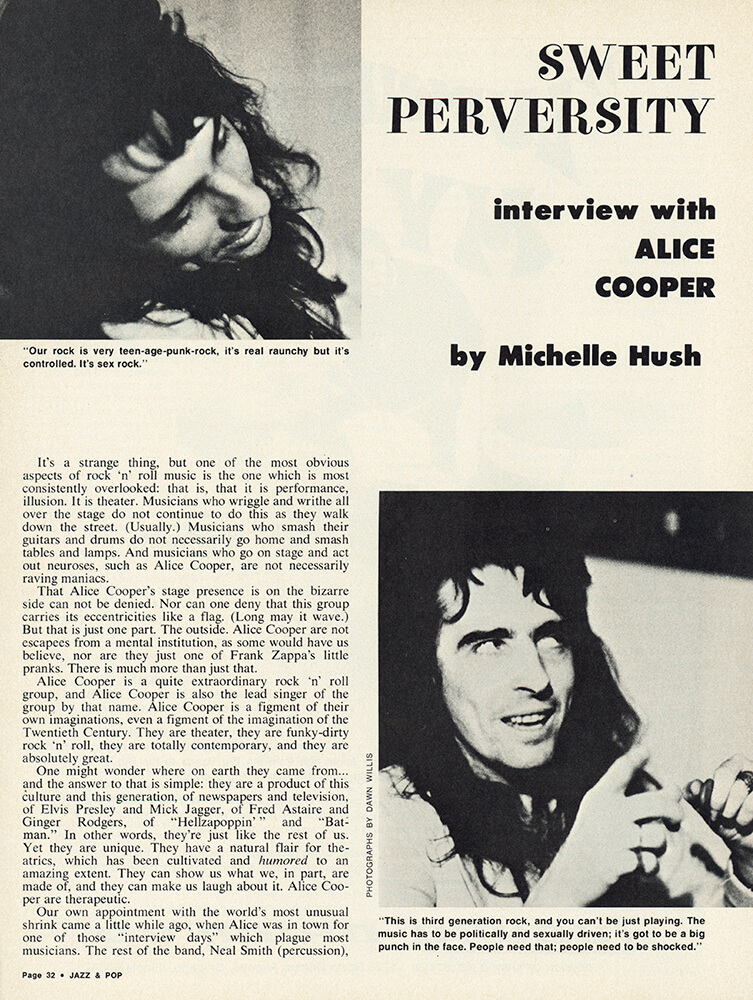
"Yeah, there is no point if you don't do that... this is third generation rock, and you can't just be playing. It's got to really be politically and sexually driving; it's got to be a big punch in the face. People need that; people need to be shocked."
Have you ever thought about expanding your "format" to include other media?
"Well, I'm thinking of producing video tapes. That's going to be a whole new field of entertainment, where you just plug it into your TV. And they're not going to be censored, because it's not a public thing. So, video tapes are going to be interesting to start working with. You can get away with a lot. Not just 'filthy' things, just very subtle things that are very funny, but at the same time, sensual."
Then humor has a lot to do with what you're doing.
"Oh yeah; it's got to be very subtle, very tongue-incheek."
Right. Because everybody is humorous.
"Yeah. Especially in New York. Times Square is the best theater in the world. You can't get actors to act any crazier than the people that are down there. New York City is so nuts. This is my favorite city to come into; I'd like to come here once every two or three weeks and really get off on the people."
How do people react to you in common, everyday shopping-in-the-supermarket life?
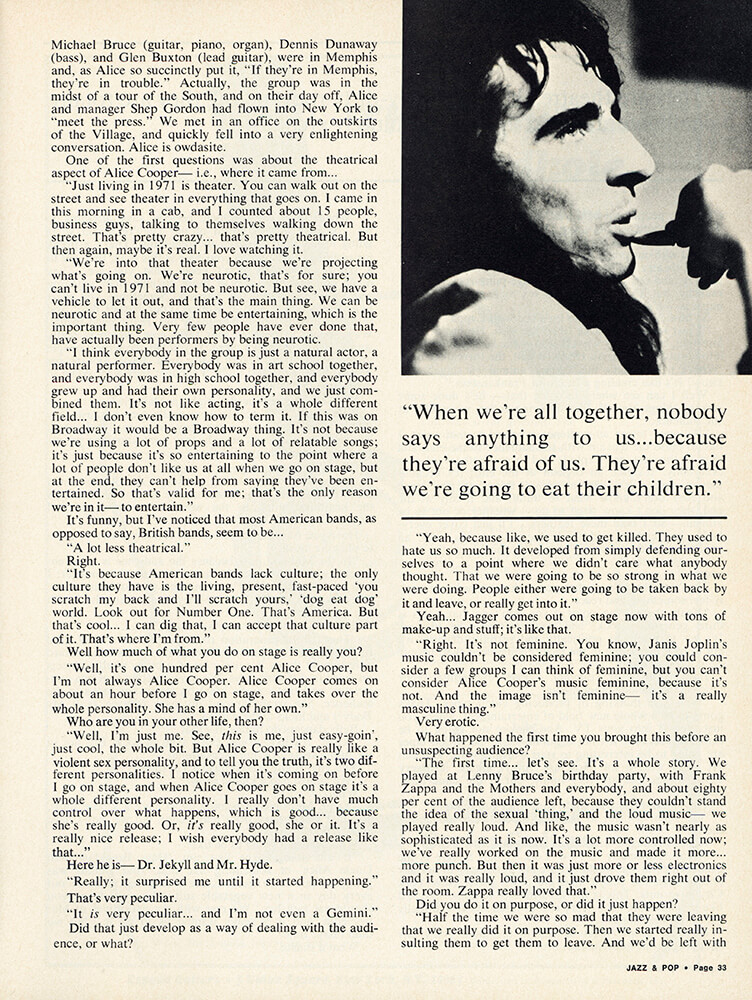
"When we're all together, nobody says anything to us... because they're afraid of us. They're afraid we're going to eat their children or something. That's a pretty weird thing... Well, when your hair is this long, they get to a point where they don't know what you are. They don't say anything, they're more curious than anything else. You meet very few hasslers. Sometimes you meet like, 'Hey whatsa matter Ringo? Your barber died?' and things like that; but they're really old, really dead inside. We're doing a southern tour right now, which is really weird. It's rough down there. If you get the wrong people at the wrong time, you're really dead. I was looking for the Ku Klux Klan last night; I thought they were going to be outside the windows."
What's it like on Tuesday night in Alabama?
"It's rough. The people were really nice because they didn't know what we were; they were really shocked. The police were rough though; they were knocking people off the stage and things like that."
People were climbing on the stage?
"Yeah, they were rushing the stage. An old-fashioned rock 'n' roll riot, which was really neat. I think that's the healthiest thing in the world — the rock 'n' roll riot."
Have you found anywhere in the country where you like to play the most?
"In the Midwest, just because the audience is more energetic, and they react a lot more. And they're younger; I like young audiences a lot. Fourteen year olds are great. They like sex music, because they're more involved with sex right then."
You've used that phrase, "sex music" a lot.
"That's third generation rock; people are sort of tired of listening to long jams, and are more interested in a hard core type of thing. We use a lot of subtly phallic objects on stage in different ways. We have an eight foot boa constrictor, and that's really great on stage. She looks at the audience. She wraps around my neck (during Is It My Body?) and looks at the audience."
Belly dancers do things like that.
"Right. It's like a vaudeville type of rock. But not in the funny sense; it's more sensational."
You guys really should have a TV show.
"We almost had a kiddie show."
What?
"Yeah, Metromedia wanted us to have a kiddie show, and that would have been really cool; but we didn't have time to do it."
What was that going to be like?
"It was going to be like, um, 'Have Breakfast with Uncle Alice' or something like that. And Dennis was going to be Mr. Vegetable. He was going to come out every day in a new vegetable suit. 'Hey, you know you should eat radishes.' We met with the executives at Metromedia, and they really wanted us to do it... but we didn't have time."
What a shame.
Images