
Article Database
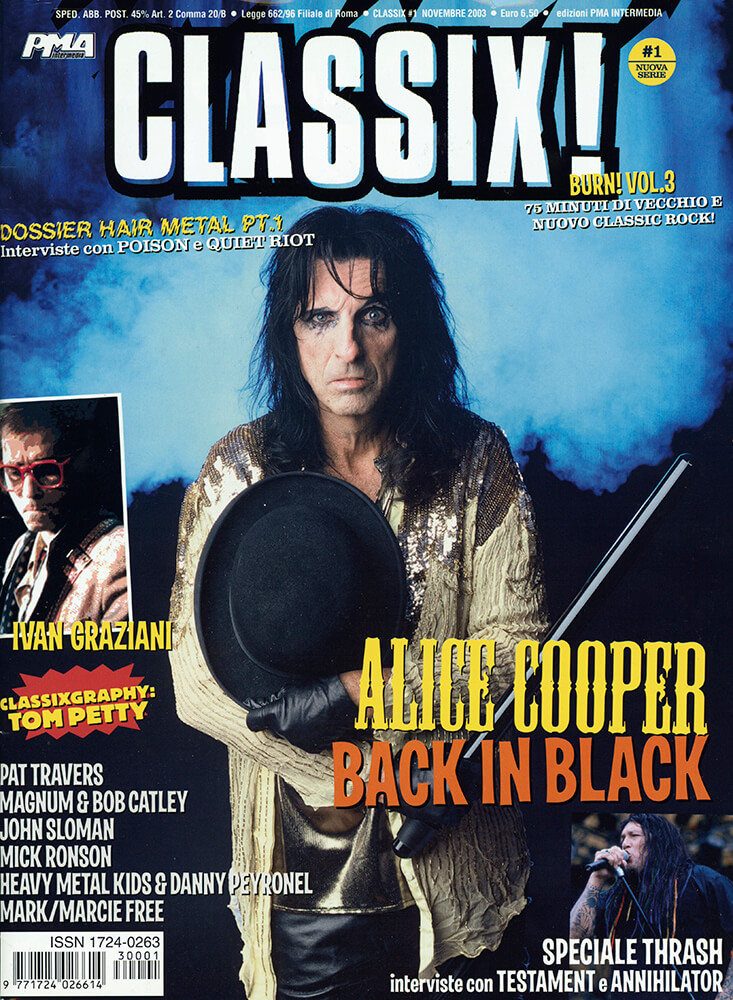
Classix!
November 2003
Back To Detroit
Author: Marco Melillo
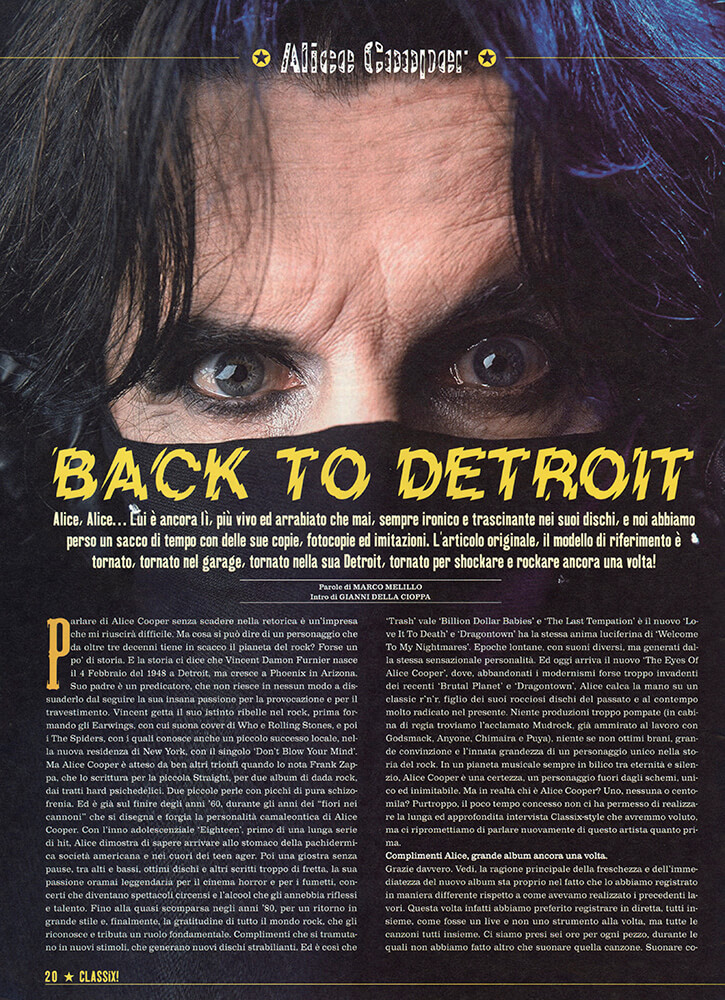
Alice, Alice... He's still there, more alive and angrier than ever, always ironic and captivating in his records, and we've wasted a lot of time with his copies, photocopies, and imitations. The original article, the reference model, has returned—returned to the garage, returned to Detroit, returned to shock and rock once again!
Speaking about Alice Cooper without slipping into rhetoric is something I'll find difficult to do. But what can you say about a figure who has kept the rock world in check for over three decades? Maybe a bit of history. And history tells us that Vincent Damon Furnier was born on February 4, 1948, in Detroit, but grew up in Phoenix, Arizona. His father was a preacher who could do nothing to dissuade him from following his unhealthy passion for provocation and disguise. Vincent channeled his rebellious instinct into rock, first forming The Earwigs, with whom he played covers of The Who and The Rolling Stones, and later The Spiders, with whom he achieved a bit of local success in his new home of New York with the single "Don’t Blow Your Mind."
But Alice Cooper was destined for far greater triumphs when he caught the attention of Frank Zappa, who signed him to his small label, Straight, for two albums of dada rock with hard-psychedelic tones — two little gems with peaks of pure schizophrenia. And it was here, at the end of the 1960s, during the years of "flowers in the gun barrels," that Alice Cooper's chameleonic personality was conceived and forged. With the adolescent anthem "Eighteen," the first of a long series of hits, Alice proved he could reach both the gut of the lumbering American society and the hearts of teenagers.
Then came a nonstop ride — through highs and lows, excellent albums and others written too hastily, his now-legendary passion for horror films and comic books, and concerts that turned into circus-like shows, and alcohol that clouded his reflexes and talent. Until his near disappearance in the 1980s, followed by a grand comeback and, finally, the gratitude of the entire rock world, which recognized and celebrated his fundamental role.
Compliments turned into new motivation, generating new, astonishing records. And so, Trash stands alongside Billion Dollar Babies, and The Last Temptation as the new Love It to Death, while Dragontown shares the same diabolical soul as Welcome to My Nightmare. Distant eras, with different sounds, yet born from the same sensational personality.
And now comes the new The Eyes of Alice Cooper, where — having left behind the perhaps overly modern touches of the recent Brutal Planet and Dragontown — Alice leans heavily into a classic rock'n'roll sound, heir to his solid albums of the past and yet deeply rooted in the present. No overblown production (at the controls is the acclaimed Mudrock, previously admired for his work with Godsmack, Anyone, Chimaira, and Puya), nothing but great songs, strong conviction, and the innate greatness of a character unique in rock history.
In a musical world forever teetering between eternity and silence, Alice Cooper is a certainty — a figure beyond conventions, unique and inimitable. But who is Alice Cooper, really? One, none, or a hundred thousand? Unfortunately, the short time available didn’t allow us to conduct the long, in-depth Classix-style interview we would have liked, but we promise to speak again about this artist very soon.
Compliments Alice — another great album once again!
Thank you so much. You see, the main reason for the freshness and immediacy of the new album lies precisely in the fact that we recorded it differently from how we made the previous ones. This time, in fact, we preferred to record live, all together, as if it were a concert — not one instrument at a time, but all the songs played together. We took about six hours for each track, during which we did nothing but play that song — play as if we were live at our last concert ever, our most important performance. We recorded everything and then chose the best version. Afterwards, we did the mixing and overdubs.
It definitely sounds very Alice Cooper — a mix of your classic sound with a breath of modernity, but without the modernist excesses of Brutal Planet and Dragontown.
The goal was exactly to sound like the old records, but with more grit and aggression — yet without using overly compressed or modern sounds. Thinking about it, it’s better this way. I’m not saying the previous two albums were bad, but this is the dimension that suits me best. On those two records, I had a lot of fun singing over super-distorted guitars, but the new album makes me feel at home. This is my environment! Nothing sounds fresher or more genuine than good, guitar-oriented rock ’n’ roll. We wanted to make classic rock, and we gave it our all to do it!
Speaking of familiar places &madsh; I saw you in concert in Brescia on the last tour. You were in great shape!
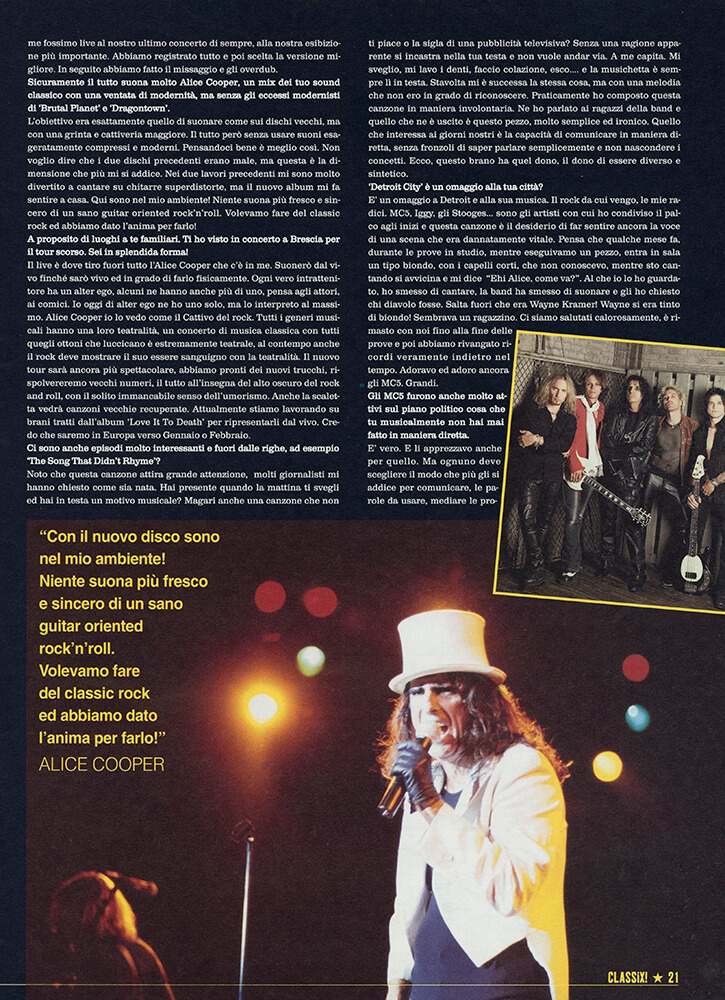
The stage is where I bring out all the Alice Cooper that's in me. I’ll play live for as long as I’m alive and physically able to do it. Every true entertainer has an alter ego — some even have more than one; think of actors, comedians. Today I have only one alter ego, but I interpret him to the fullest. I see Alice Cooper as the Villain of Rock.
Every musical genre has its own theatricality — a classical concert, with all those shining brass instruments, is extremely theatrical. Likewise, rock has to show its rawness through theatrics. The new tour will be even more spectacular; we’ve got some new tricks ready and will dust off some old numbers, all in the name of the dark side of rock and roll, with the usual unmistakable sense of humor.
The setlist will also feature some older songs brought back. Right now, we’re working on tracks from the Love It to Death album to perform them live again. I think we'll be in Europe around January or February.
There are also some very interesting and unconventional moments — for example, "The Song That Didn't Rhyme"?
I've noticed that this song draws a lot of attention — many journalists have asked me how it came about. You know when you wake up in the morning with a tune stuck in your head? Maybe it's even a song you don’t like, or the jingle from a TV commercial? For no apparent reason, it gets lodged in your mind and won't go away. That happens to me. I wake up, brush my teeth, have breakfast, go out... and that little tune is still there in my head.
This time, the same thing happened — but with a melody I couldn't recognize. So, basically, I composed this song unintentionally. I talked to the guys in the band, and what came out was this piece — very simple and ironic. What matters nowadays is the ability to communicate directly, without frills, to know how to speak simply and not hide the ideas. And that's exactly what this song has — the gift of being different and concise.
"Detroit City" is a tribute to your hometown?
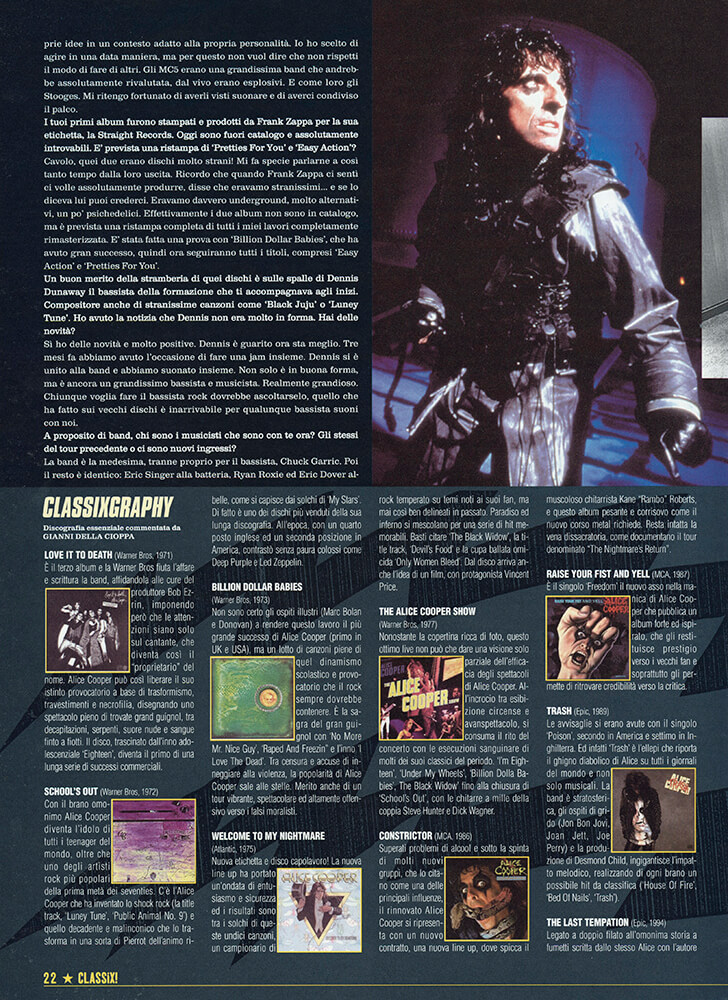
It's a tribute to Detroit and its music — the rock I come from, my roots. MC5, Iggy, the Stooges... those are the artists I shared the stage with in the early days, and this song is my way of giving voice once again to a scene that was damn alive.
Just think — a few months ago, during rehearsals in the studio, while we were playing a song, this blond guy with short hair walks in. I didn't recognize him. While I'm singing, he comes up to me and says, "Hey Alice, how’s it going?" So I look at him, stop singing, the band stops playing, and I ask who the hell he is. Turns out it was Wayne Kramer! Wayne had dyed his hair blond! He looked like a kid. We greeted each other warmly, he stayed with us until the end of rehearsals, and then we reminisced — really going way back in time. I loved, and still love, the MC5. Great guys.
The MC5 were also very active on a political level — something you’ve never really done directly in your music.
That’s true — and I appreciated them for that as well. But everyone has to choose the way that best suits them to communicate — the words to use, how to express their ideas in a way that fits their own personality. I chose to act in a certain way, but that doesn’t mean I don't respect how others do it. The MC5 were a truly great band that absolutely deserves to be re-evaluated — live, they were explosive. And the same goes for the Stooges. I consider myself lucky to have seen them play and to have shared the stage with them.
Your first albums were released and produced by Frank Zappa on his label, Straight Records. Today they’re out of print and practically impossible to find. Is there any plan for a reissue of Pretties for You and Easy Action?
Wow, those were really strange records! It feels odd to talk about them after all this time. I remember that when Frank Zappa heard us, he absolutely wanted to produce us — he said we were really weird... and if he said that, you can believe it! We were truly underground, very alternative, a bit psychedelic.
It's true that those two albums aren't currently in catalog, but there's a complete reissue planned — all my work, fully remastered. A test run was done with Billion Dollar Babies, which was very successful, so now all the titles will follow, including Easy Action and Pretties for You.
A good part of the weirdness of those records rests on the shoulders of Dennis Dunaway, the bassist from the original lineup that played with you in the early days — also the composer of wonderfully strange songs like "Black Juju" and "Luney Tune." I heard that Dennis hasn’t been in great shape lately. Do you have any news?
Yes, I do have news — and very good news. Dennis has recovered and is doing much better now. About three months ago, we had the chance to do a jam together. Dennis joined the band, and we played together. Not only is he in great shape, but he's still an incredible bassist and musician — truly outstanding. Anyone who wants to be a rock bassist should listen to him; what he did on those old records is unbeatable for any bassist who's ever played with us.
Speaking of the band — who are the musicians playing with you now? Are they the same ones from the previous tour, or are there some new members?
The band is the same, except for the bassist — Chuck Garric. The rest is unchanged: Eric Singer on drums, Ryan Roxie and Eric Dover on guitars. This time, no keyboards. We preferred a more direct, guitar-driven sound; the keyboards made us lose some of our grit and aggressiveness, so we decided to leave them out!
During your career, you’ve had the chance to meet many artists. I'm especially curious to know something about your meeting with Elvis Presley.
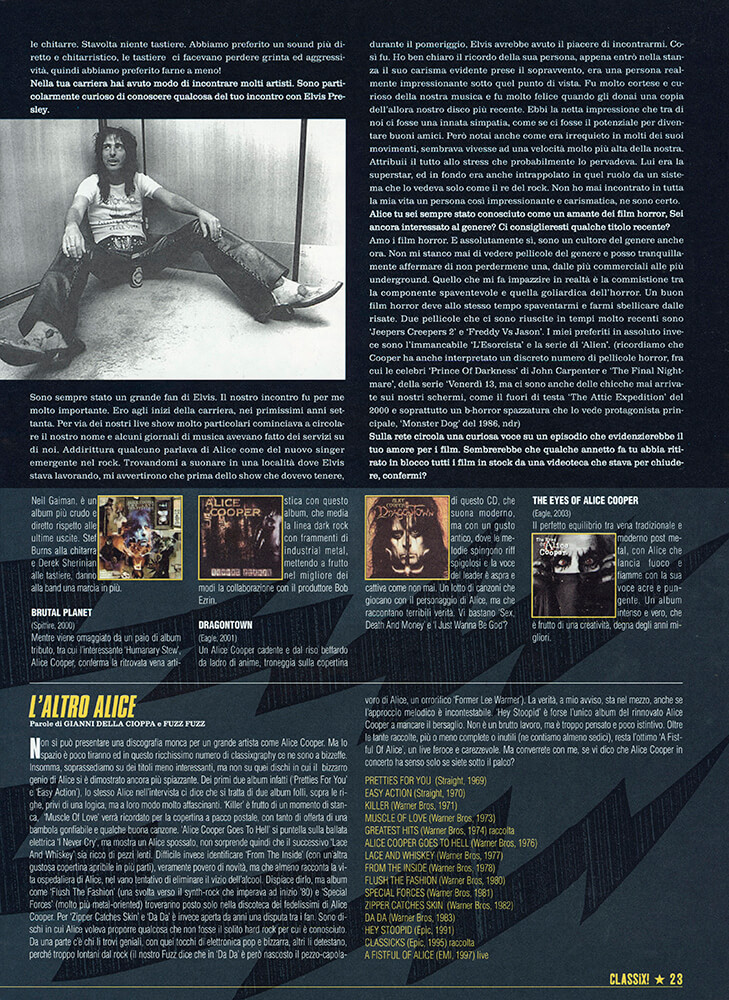
It was at the beginning of my career, in the very early seventies. Because of our very unusual live shows, our name had started to spread around, and some music magazines had begun writing about us. Some were even calling Alice the new emerging rock singer.
I happened to be playing in a place where Elvis was performing at the same time, and I was told that before my show, in the afternoon, Elvis wanted to meet me. And that's exactly what happened. I remember him vividly — the moment he walked into the room, his charisma just took over. He was truly impressive in that sense. He was very polite and curious about our music, and he was really pleased when I gave him a copy of our most recent record at the time.
I had a strong feeling that there was an instant mutual liking between us — as if there was potential for a real friendship. But I also noticed how restless he seemed in many of his movements, like he was living at a much faster speed than the rest of us. I figured it must have been the stress that constantly surrounded him. He was the superstar, after all, and in a way, he was trapped in that role by a system that only saw him as the King of Rock. I've never met anyone in my life as impressive and charismatic as Elvis Presley — I'm sure of that.
Alice, you’ve always been known as a lover of horror films. Are you still interested in the genre? Would you recommend any recent titles?
I love horror movies. And yes, absolutely — I'm still a devotee of the genre. I never get tired of watching those kinds of films, and I can honestly say I don't miss a single one, from the most commercial to the most underground. What really drives me crazy, actually, is the blend between the frightening and the tongue-in-cheek sides of horror. A good horror film should both scare me and make me burst out laughing.
Two movies that have managed to do that very recently are Jeepers Creepers 2 and Freddy vs. Jason. My all-time favorites, though, are the unmissable The Exorcist and the Alien series.
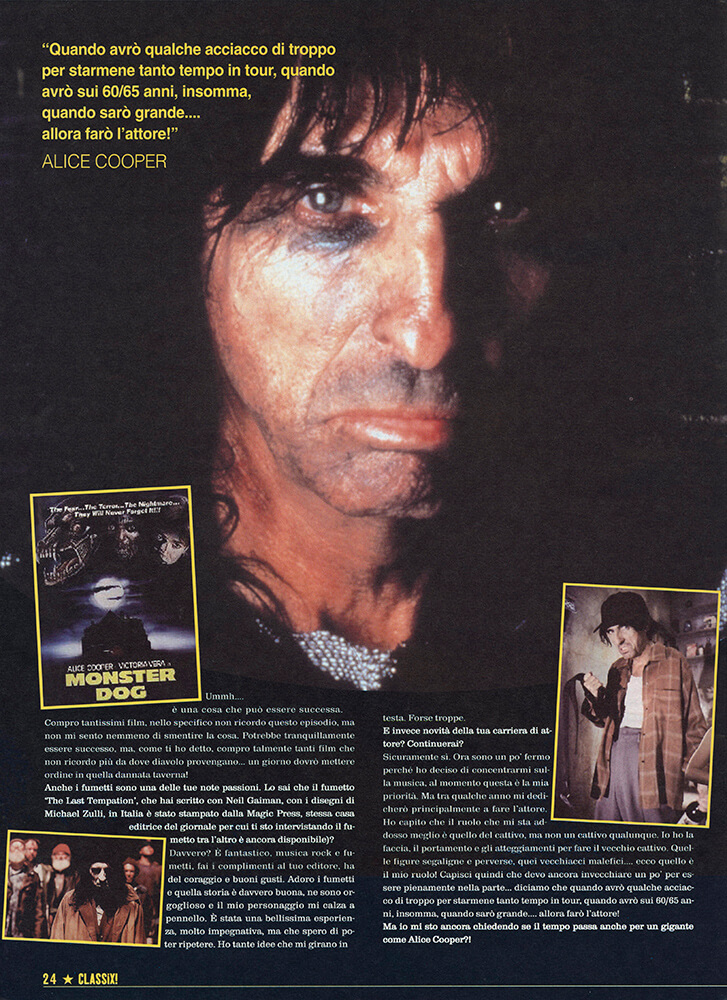
(Let’s remember that Cooper has also appeared in a fair number of horror films himself — including the famous Prince of Darkness by John Carpenter and The Final Nightmare from the Friday the 13th series — but there are also some gems that never reached our screens, such as the insane The Attic Expeditions from 2000 and, above all, a trashy B-horror where he plays the lead role, Monster Dog from 1986).
There’s a curious story going around online that seems to show your love for movies. Apparently, a few years ago, you bought out the entire stock of films from a video store that was about to close — can you confirm that?
Umm... that’s something that could very well have happened. I buy a lot of movies — I don’t specifically remember that episode, but I can’t deny it either. It could easily have happened. As I said, I buy so many films that I can't even remember where the hell they all came from... One of these days, I'll have to organize that damned basement!
Comics are also one of your well-known passions. Did you know that The Last Temptation &mdsah; the comic you wrote with Neil Gaiman, illustrated by Michael Zulli — was published in Italy by Magic Press, the same publishing house as the magazine I'm interviewing you for? The comic, by the way, is still available!
Really? That’s fantastic — rock music and comics! Compliment your publisher for me; they've got courage and good taste. I love comics, and that story is a really good one — I'm proud of it, and the character fits me perfectly. It was a wonderful experience, very demanding, but one I hope to repeat. I've got so many ideas swirling around in my head. Maybe too many!
And what about your acting career — any news there? Will you continue?
Definitely yes. Right now, I'm taking a bit of a break because I've decided to focus on music — at the moment, that's my priority. But in a few years, I'll dedicate myself mainly to acting. I've realized that the role that suits me best is that of the villain — but not just any villain. I've got the face, the posture, and the mannerisms to play the old villain — those gaunt, twisted figures, those wicked old men... that's my role!<;p>
So you see, I still need to get a bit older to truly fit the part. Let's just say that when I've got a few more aches and pains that keep me from touring for too long — when I'm around 60 or 65, in other words, when I'm "grown up"... then I'll be an actor!
But I’m still wondering — does time even pass for a giant like Alice Cooper?!
Classixgraphy
LOVE IT TO DEATH (Warner Bros. 1971)
And the third album arrives. Warner Bros. smells the opportunity and signs the band, entrusting them to producer Bob Ezrin, while insisting that all attention be focused on the singer — who thus becomes the owner of the name. This allows Alice Cooper to fully unleash his provocative instincts, built on transformism, costumes, and a morbid theatricality, crafting a grand guignol spectacle filled with decapitations, snakes, naked nuns, and streams of fake blood. The record ‐ driven by the adolescent anthem "I'm Eighteen" — becomes the first in a long line of commercial successes.
SCHOOL'S OUT (Warner Bros, 1972)
With the title track, Alice Cooper becomes the idol of teenagers all over the world — as well as one of the most popular rock artists of the early seventies. There's the Alice Cooper who invented shock rock (as heard in the title track, "Luney Tune," "Public Animal No. 9"), and the decadent, melancholic Alice, a kind of Pierrot of the rebellious soul, embodied in songs like "My Stars." In fact, it remains one of the best-selling albums in his long discography. At the time, with a #4 position in the U.K. and #2 in the U.S., it fearlessly rivaled giants like Deep Purple and Led Zeppelin.
BILLION DOLLAR BABIES (Warner Bros, 1973)
It's certainly not the presence of distinguished guests (Marc Bolan and Donovan) that makes this record Alice Cooper's greatest success (reaching #1 in both the U.K. and the U.S.), but rather a set of songs bursting with that rebellious, schoolyard dynamism that rock should always possess. It's a true grand guignol spectacle, with tracks like "No More Mr. Nice Guy," "Raped and Freezin'," and the anthem "I Love the Dead." Amid censorship and accusations of promoting violence, Alice Cooper's popularity skyrockets — thanks also to a vibrant, spectacular tour, one that was highly offensive to hypocritical moralists.
WELCOME TO MY NIGHTMARE (Atlantic, 1975)
A new label and a masterpiece album! The new lineup brought a wave of enthusiasm and confidence, and the results shine through in these eleven tracks — a collection of rock songs shaped around themes well-known to Alice's fans, yet never so clearly defined before. Heaven and hell intertwine, giving life to a series of unforgettable hits: just mention "The Black Widow," the title track, "Devil’s Food," and the dark, haunting ballad "Only Women Bleed." From this album also came the idea for a film, featuring none other than Vincent Price in a leading role.
THE ALICE COOPER SHOW (Warner Bros, 1977)
Despite a cover packed with photos, this excellent live album can only offer a partial glimpse of the true power and impact of Alice Cooper’s stage shows. At the crossroads between circus performance and vaudeville, the concert becomes a full-blown ritual — featuring blood-soaked renditions of many of his classic tracks from the era: "I'm Eighteen," "Under My Wheels," "Billion Dollar Babies," "The Black Widow," and closing with "School's Out," driven by the blazing twin guitars of Steve Hunter and Dick Wagner.
CONSTRICTOR (MCA, 1986)
Having overcome his alcohol problems and inspired by a wave of new bands citing him as a major influence, a revitalized Alice Cooper returned with a new record deal, a fresh lineup — featuring the powerhouse guitarist Kane "Rambo" Roberts — and an album as heavy and corrosive as the new metal era demanded. His irreverent streak remained untouched, as documented by the tour aptly titled "The Nightmare Returns."
RAISE YOUR FIST AND YELL (MCA, 1987)
And the single "Freedom" is Alice Cooper’s new ace up his sleeve, taken from a powerful and inspired album that restores his prestige among longtime fans and, above all, allows him to regain credibility with critics.
TRASH (Epic, 1989)
The first signs came with the single "Poison," which reached No. 2 in the U.S. and No. 7 in the U.K. Indeed, "Trash" is the album that brought Alice’s devilish grin back to the pages of newspapers all over the world — not just the music press. The band is phenomenal, the guest list impressive (Jon Bon Jovi, Joan Jett, Joe Perry), and Desmond Child's production amplifies the melodic impact, turning practically every track into a potential chart hit — from "House of Fire" to "Bed of Nails" and the title track "Trash."
THE LAST TEMPTATION (Epic, 1994)
Closely tied to the comic book of the same name, written by Alice himself together with author Neil Gaiman, this album is grittier and more direct than his recent releases. With Stef Burns on guitar and Derek Sherinian on keyboards, the band gains an extra edge — delivering power, precision, and a renewed sense of intensity.
BRUTAL PLANET (Spitfire, 2000)
While being honored with a couple of tribute albums &mdah; including the noteworthy “Humanary Stew” — Alice Cooper confirms his revived creative energy with this record, which blends dark rock with touches of industrial metal, making the most of his renewed collaboration with producer Bob Ezrin.
DRAGONTOWN (Eagle, 2001)
A decaying, sneering, soul-stealing Alice Cooper dominates the cover of this CD — an album that sounds modern yet steeped in old-school spirit, where melodies drive jagged riffs and Alice's voice is harsher and meaner than ever. A collection of songs that play with the Alice persona while revealing grim truths beneath the surface. Need proof? Just listen to "Sex, Death and Money" and "I Just Wanna Be God."
THE EYES OF ALICE COOPER (Eagle, 2003)
The perfect balance between traditional roots and modern post-metal, with Alice spitting fire and venom through his sharp, biting voice. An intense and authentic album, the product of a creative spark worthy of his finest years.
The Other Alice
Author: Gianni Della Cioppa and Fuzz Fuzz
You can’t present an incomplete discography for a great artist like Alice Cooper. But space is a cruel tyrant, and in this rich issue of Classixgraphy there are plenty of names to cover. So, let’s skip over the less interesting titles, but not those albums where Alice’s bizarre genius proved even more disorienting than usual.
Of the first two albums (Pretties For You and Easy Action), Alice himself told us in the interview that they're "crazy, over-the-top records, lacking logic but fascinating in their own way." Killer was the result of a momentary lull, while Muscle of Love is mostly remembered for its postal-package cover, complete with an offer for an inflatable doll and a few good songs. Alice Cooper Goes to Hell leans on the electric ballad "I Never Cry" but shows a weary Alice — so it's no surprise that the follow-up, Lace and Whiskey, is filled with slower numbers.
It's harder to define From the Inside (with another fun multi-panel fold-out cover), which is truly short on new ideas, though at least it recounts Alice's time in a sanitarium, during his failed attempt to kick his alcohol habit. Sadly, albums like Flush the Fashion (a turn toward the synth-rock dominating the early '80s) and Special Forces (more metal-oriented) end up as collector's items for die-hard fans only.
As for Zipper Catches Skin and DaDa, fans have been debating them for years. These are albums where Alice tried to break away from his usual hard rock, offering something different. Some find them brilliant, with their touches of odd pop electronics, while others detest them for straying too far from rock. (Our own Fuzz claims that DaDa hides Alice’s masterpiece — the horrific "Former Lee Warmer.") The truth, in my opinion, lies somewhere in between, though their melodic approach is undeniable.
Hey Stoopid is perhaps the only album from the reborn Alice Cooper that misses the mark — not a bad record, but too calculated and not instinctive enough. Beyond the many compilations — more or less complete or completely useless (we counted at least sixteen) — there remains the excellent A Fistful of Alice, a live album both fierce and tender. But I think you'll agree with me when I say that Alice Cooper only truly makes sense live when you’re standing right beneath the stage.
(Original published in the first issues of Italian magazine Classix!, November 2003. Translated to English from the original Italian language publication, November 2025)
Images